
5.1 KiB
Simple SpaceAPI
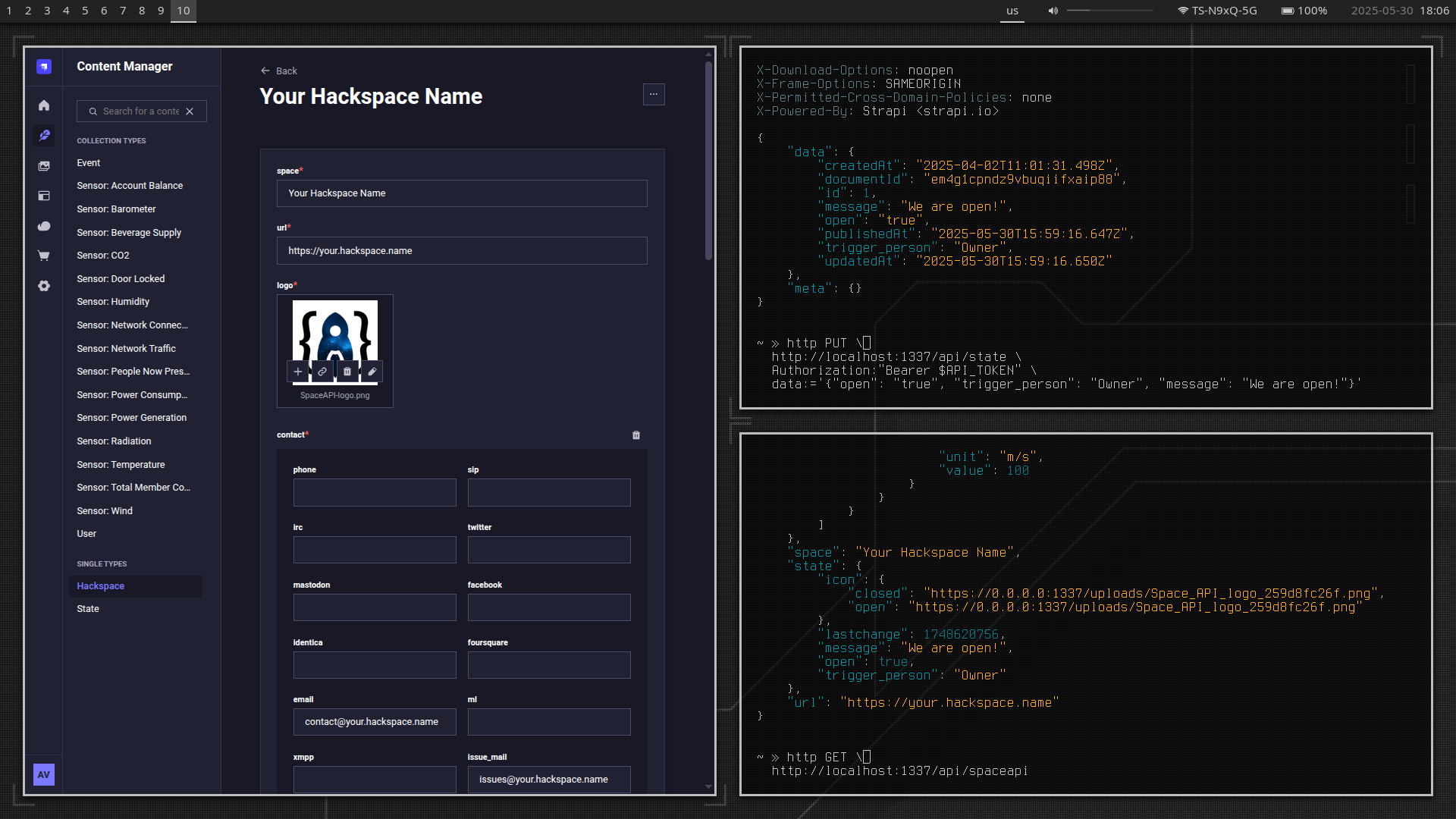
A lightweight SpaceAPI server with both web and REST interfaces.
Built with Node.js and Strapi.
Quick Start
Install dependencies and start the server in development mode:
npm install
npm run develop
Most files are autogenerated.
The main entry point is ./src/api/spaceapi/controllers/spaceapi.ts.
Usage
Just fill in the data according to the Schema Documentation. Version 15 is implemented.
All endpoint data can be added or modified via the admin panel or through the REST API.
To list all available API endpoints, use the Strapi CLI:
npm run strapi routes:list
API Tokens
To update data using requests, you need an API token.
Tokens can be generated and managed in the admin panel under Settings → API Tokens. You can also define token-specific permissions there.
For more details, see the Strapi API Tokens Documentation.
Examples
Some example requests using the HTTPie CLI:
Get the Main SpaceAPI Endpoint Info
http GET http://localhost:1337/api/spaceapi
Update the Hackspace State
API_TOKEN=your-token-here

http PUT \
  http://localhost:1337/api/state \
  Authorization:"Bearer $API_TOKEN" \
  data:='{
    "open": "true",
    "trigger_person": "Owner",
    "message": "We are open!"
  }'
Update a Sensor
API_TOKEN=your-token-here

# Discover the `documentId` for the Sensor
http GET \
  http://localhost:1337/api/temperature-sensors \
  Authorization:"Bearer $API_TOKEN"

DOCUMENT_ID=nrfn2800pexpwxuhqikzr7xa

http PUT \
  http://localhost:1337/api/temperature-sensors/$DOCUMENT_ID \
  Authorization:"Bearer $API_TOKEN" \
  data:='{
    "unit": "°C",
    "value": 25
  }'
Add an Event
API_TOKEN=your-token-here

http POST \
  http://localhost:1337/api/events \
  Authorization:"Bearer $API_TOKEN" \
  data:='{
    "name": "3D printer",
    "type": "finish-print",
    "extra": "Model: Evangelion Unit-01"
  }'
Caveats
Timestamps
Simple SpaceAPI does not attempt to be smart about timestamps,
so any successful request will update the corresponding lastchange field.
For example, if you set the hackspace state to "closed"
and repeat the same request the next day,
the lastchange field will be updated.
Validation
While Simple SpaceAPI performs basic data validation, it's still possible to produce invalid SpaceAPI JSON.
Always validate your endpoint using the SpaceAPI Validator.
Units
Due to some Strapi limitations, certain sensor units must be replaced with aliases in API requests:
- Humidity Sensor: use
percentinstead of% - Wind Sensor: use
degreeinstead of°
The main SpaceAPI endpoint will display the correct units.
Sensor Structure
While Simple SpaceAPI follows the general SpaceAPI format, the internal structure of some sensors is simplified:
- Radiation sensors (
alpha,beta,gamma,beta_gamma) are unified into a singleradiationtype. The exact subtype can be specified using thetypefield.
state.open Field
While the SpaceAPI specification defines state.open
as a boolean (true or false),
Simple SpaceAPI expects string values: "true", "false", or "undefined".
Boolean values (true, false) are technically accepted
and will be parsed correctly, but this behavior is not recommended.
Deployment
Environment Variables
Before running the production server, you need to configure environment variables.
Start by copying the example file and editing it:
cp ./.env.example ./.env
Running with Docker Compose
Once the environment variables are set up, you can start the server using Docker Compose:
docker compose up --build
By default, the server will be available at http://0.0.0.0:1337/.
The database and uploaded user files are stored in the ./data directory.
You can change this behavior by editing the .env file
or the docker-compose.yml file, if needed.
Note: Environment variables defined in docker-compose.yml
will override those in the .env file.
Running with Node.js
If you prefer to run the server without Docker, you can use Node.js directly.
npm install --omit=dev
npm run build
It is recommended to run the server using PM2:
npm install pm2@latest --global
pm2 start npm -- start
Alternatively, the application can be started directly with:
npm start
By default, the server will be available at http://0.0.0.0:1337/.
You can change this behavior by editing the .env file, if needed.